










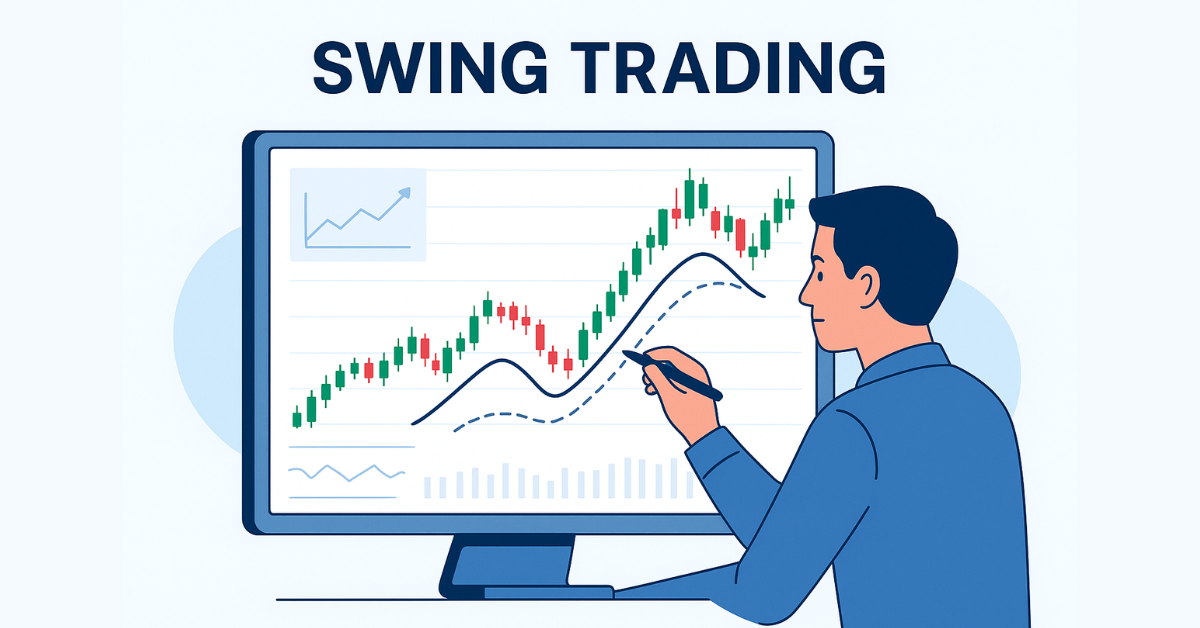
Swing trading is one of the most popular trading styles because it strikes the perfect balance between intraday trading and long-term investing. You don’t need to sit in front of charts all the day, and your don’t need to hold stocks for years. Instead, you aim to capture short-term price swings that occur over a few days or weeks.
If you’re a beginner or even an intermediate trader looking to understand how swing trading works, this guide will walk you through everything step-by-step.
What is Swing Trading?
Swing trading is a trading method where traders aim to capture “swings” or price movements in a stock over a short to medium time frame—usually 2 days to 3 – 4 weeks.
These swings occur due to:
- Market sentiment
- Earnings news
- Technical patterns
- Support/resistance reactions
- Trend continuation or reversal setups
Swing traders don’t look for huge multi-year moves. Instead, they target quick and consistent profits of 3–10% per trade.
Key idea:
Buy low when the trend is likely to rise → Sell high when the momentum slows
OR
Sell high (short sell) when price is likely to fall → Buy low to close the position.
How Does Swing Trading Work?
Swing trading works based on technical analysis, market psychology, and price patterns. Traders don’t try to predict big moves; instead, they catch the middle of a move.
1. Identifying Market Trend
Swing traders first analyze whether the stock is:
- In an uptrend (higher highs, higher lows formation in chart)
- In a downtrend (lower highs, lower lows formation in chart)
- In a range-bound zone
Uptrends are ideal for buying swings, and downtrends are ideal for short-selling swings.
2. Finding the Right Entry Point
Once the trend is clear, traders wait for:
- Pullbacks in an uptrend
- Rallies in a downtrend
- Breakouts from consolidation/ range bound zone
Popular tools used:
- Moving Averages (20 EMA, 50 EMA, 200 EMA)
- RSI (30–70 zones)
- Fibonacci retracement
- Trendlines & support/resistance
- Managing Risk
A professional swing trader always sets:
- Stop-loss (SL)
- Target (TP)
- Position size
Risk per trade is usually kept at 1–2% of account value.
4. Exit at Momentum Weakness
Swing traders don’t wait for perfect peaks. They exit when:
- Price hits resistance
- Momentum indicators weaken
- Trend shows reversal signs
Also Read:
How to Start Swing Trading (Step-by-Step Guide)
Step 1: Choose the Right Stocks
Swing traders prefer stocks with:
- High liquidity
- Strong price movement
- Clear trends
- Good volume
Examples in India: Tata Motors, HDFC Bank, Infosys, Reliance, L&T, Maruti
Avoid penny stocks—they are unpredictable and risky.
Step 2: Analyze the Trend
Use daily charts (1D time frame).
- If price is above 50 EMA → it is considered as Uptrend
- If price is below 50 EMA → it is considered as Downtrend
Look for higher highs & higher lows.
Step 3: Identify Entry Setup
Popular swing trading entry patterns:
1. Pullback Trading – Enter when stock retraces to:
- 20 EMA/50 EMA
- 38.2% or 50% Fibonacci level
- Previous swing low
This is the safest swing technique.
2. Breakout Trading – Enter when price breaks:
- Resistance
- Trendline
- Consolidation zone
Confirm with volume before entering into the position or trade.
3. Reversal Trading – In this case enter near:
- Strong support – from support you can plan for buying a stock.
- RSI oversold (below 30) – it indicate stock is oversold and may it bounce back.
- Bullish candlestick patterns (Hammer, Engulfing)
Step 4: Set Stop-Loss & Targets
Stop-loss:
a. Place Stop Loss below support or recent swing low for buy trades.
b. Place SL above resistance for short trades.
Target:
1:2 or 1:3 risk-to-reward ratio or more.
(E.g., if SL is ₹10, target should be ₹20–₹30)
Step 5: Manage Your Trade
Good swing traders:
- Move SL to cost after 50% target
- Book partial profits
- Never average your losing trade
- Never trade without Stop Loss
Also read:
Best Swing Trading Indicators
Here are 4 indicators that work exceptionally well:
- Moving Averages (20 EMA + 50 EMA) – Helps spot trend & pullbacks
- RSI (Relative Strength Index) – Identifies overbought & oversold zones
- MACD – Confirms trend strength and momentum
- Volume – Confirms breakouts & reversals
Keep your setup simple. Too many indicators create confusion.
Best Timeframe for Swing Trading
Use multi-timeframe analysis:
- Daily chart (1D) → you can make best decision using daily chart time frame.
- Hourly chart (1H) → Hourly time frame is best for entry/exit.
- Weekly chart (1W) → It show big trend direction like bullish or bearish.
Advantages of Swing Trading
- Suitable for working professionals
- Less stressful than day trading
- Higher profit potential than long-term investing
- No need to watch charts all day
- Clear, predictable setups
Risks of Swing Trading
- Overnight gap-up or gap-down risks
- Market volatility can hit stop loss
- Wrong trend analysis gives you losses
- Swing trading requires more discipline & patience
Who Should Do Swing Trading?
Swing trading is ideal for:
- Working professionals
- Students
- People who prefer part-time trading along with their job
- Those who want consistent medium-term profits
Not suitable for:
- Emotionally reactive traders
- People without a risk-management plan
Final Thoughts
Swing trading is one of the most effective ways to grow your capital if you understand trend, timing, and risk management. It offers a balance between flexibility and profit potential, making it perfect for part-time or side traders.
Focus on:
- Clear setups
- High-probability entries
- Strict stop-loss
- Disciplined exits
If you follow a defined plan, swing trading can become a powerful strategy in your trading journey.
Disclaimer
The content on this platform is for informational and educational purposes only and should not be considered financial, investment, or legal advice. While we strive to provide accurate and up-to-date information, we do not guarantee the completeness, reliability, or suitability of the information provided.





Thank you for your sharing. I am worried that I lack creative ideas. It is your article that makes me full of hope. Thank you. But, I have a question, can you help me?
Yes, You can ask
Thanks for sharing. I read many of your blog posts, cool, your blog is very good.
I don’t think the title of your article matches the content lol. Just kidding, mainly because I had some doubts after reading the article. https://accounts.binance.com/en/register?ref=JHQQKNKN